
Towards an effective treatment of glioblastoma
GLIOBREAK is organised to advance the small molecule degrader BEA-17 in parallel across chemistry, biology, and clinical strategy, converging on a single endpoint: a complete, biomarker-anchored Clinical Trial Application within 30 months.
Project summary
From Bench to Clinical Trial Application
GLIOBREAK is structured into nine interconnected work packages designed to deliver a safe and novel, small molecule-based treatment for glioblastoma with a companion diagnostic for patient selection for clinical evaluation and subsequent use.
WP 01/02
Project Management
Provide a comprehensive document for tracking the progress of all project-related activities, offering a structured framework for decision-making, and optimizing project execution
- 01. Create a website for clear and effective communication with scientists and the public
- 02. Coordinate project to prevent unnecessary delays
- 03. Risk identification and mitigation
WP 03
Chemistry, Manufacturing, and Controls (CMC)
Translating a drug candidate into a clinical-grade medicine requires far more than a working synthesis. GLIOBREAK will optimise the BEA-17 manufacturing route for scalability and reproducibility, establish full analytical characterisation of the drug substance, and qualify stability-indicating methods that meet regulatory expectations.
A key deliverable is a CNS-penetrant formulation suited to the glioblastoma indication, ensuring adequate drug exposure in brain tissue. All CMC work is executed to the standard required for inclusion in an Investigational Medicinal Product Dossier (IMPD).
- 01. Establish a robust and scalable manufacturing and quality control process for BEA- 17, suitable for Good Manufacturing Practice (GMP) production
- 02. Produce BEA-17 for GLP compliant animal testing
- 03. Confirm the clinical trial formulation for CTA submission
WP 04
Pharmacokinetics and Safety
Before BEA-17 can be administered to patients, its safety profile and pharmacokinetic behaviour must be characterised under GLP conditions. GLIOBREAK will conduct a programme of GLP-compliant toxicology studies alongside comprehensive ADME profiling, covering absorption, distribution, metabolism, excretion, and CNS penetration.
Bioanalytical methods will be qualified to support quantitative measurement of BEA-17 and its metabolites in biological matrices. Safety pharmacology assessments (cardiovascular, CNS, respiratory) will complete the non-clinical package required by ICH S7A/S7B and EMA/FDA guidelines.
- 01. Establish exposure parameters (e.g., bioavailability, half-life, clearance) in relevant species
- 02. Evaluate safety and tolerability across a range of dose levels
- 03. Define the therapeutic window and propose a safe starting dose for first-in-human trials
WP 05
In vivo evaluation
WP 05 will demonstrate efficacy of BEA-17 in combination with clinical standard-of-care therapy in clinically relevant immune-competent GBM mouse models. The information will feed into the development of a biomarker (WP 06)
- 01. To demonstrate efficacy of BEA-17
- 02. Generate molecular signatures of BEA-17 therapy for biomarker development
WP 06
Biomarker Framework development and Patient Stratification
GLIOBREAK's biomarker strategy builds directly on GLIOMATCH, a preceding project that generated a comprehensive single-cell atlas of GBM tumour-host interactions. The work is led by the Laboratory of Precision Cancer Medicine (LPCM) at KU Leuven, directed by Prof. Frederik De Smet, the same group that coordinated GLIOMATCH and now leads WP 06 in GLIOBREAK.
Single-cell RNA sequencing and multi-omics profiling of patient biopsies will identify the transcriptional and epigenetic signatures that predict sensitivity to BEA-17, particularly tumours with high LSD1/CoREST activity and an immune-suppressive microenvironment. These outputs are distilled into a clinically measurable biomarker panel to drive prospective patient enrichment in Phase I.
- 01. Identify predictive biomarkers
- 02. Integrate and validate biomarkers
- 03. Define patient subgroups most likely to benefit from BEA-17
WP 07
Regulatory and compliance
Compilation of regulatory-grade documentation for CTA (EMA) and IND (FDA) submissions
- 01. Submission of CTA to regulatory authority
WP 08/09
Business development, Exploitation, Communication, and Dissemination
Develop strategies for commercialization, market positioning, and effective stakeholder communication to maximize project impact.
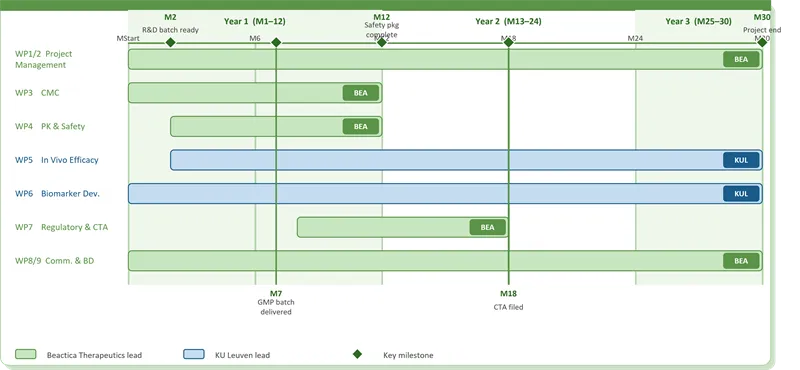
Project overview
CMC (WP3), with its production of BEA-17, provides materials for both the pharmacokinetic and safety (WP4) as well as in vivo evaluation (WP5) . The latter in turn provides material for the biomarker development (WP6). Results from WP3-6 all come together in WP7 (regulatory and compliance) and the compilation of a Clinical Trial Application (CTA).