Disease Context
What glioblastoma is, why outcomes remain poor despite decades of effort, and why a fundamentally different treatment approach is needed.

Science
Science overview
What glioblastoma is, the biological rationale for targeting the LSD1/CoREST complex, and how BEA-17 works.
What glioblastoma is, why outcomes remain poor despite decades of effort, and why a fundamentally different treatment approach is needed.
Glioblastoma (GBM) is the most common and aggressive primary brain tumour in adults. Under the 2021 WHO classification, glioblastoma is an IDH-wildtype, CNS WHO grade 4 diffuse astrocytic tumour.6, 7
GBM grows rapidly and diffusely into surrounding brain tissue, making complete surgical resection impossible. Extensive intratumoural heterogeneity - multiple co-existing cancer cell populations - drives early resistance to any single treatment.6, 8
US registry data for 2017-2021 report an average annual incidence of 3.27 per 100,000. Incidence varies by age, sex, ancestry, and geography.7
In the pivotal trial of radiotherapy plus concomitant and adjuvant temozolomide, median overall survival was 14.6 months. Radiotherapy plus temozolomide has remained a core treatment backbone since 2005.6, 9
Immunotherapies have not yet produced consistent benefit in unselected glioblastoma populations.6, 10
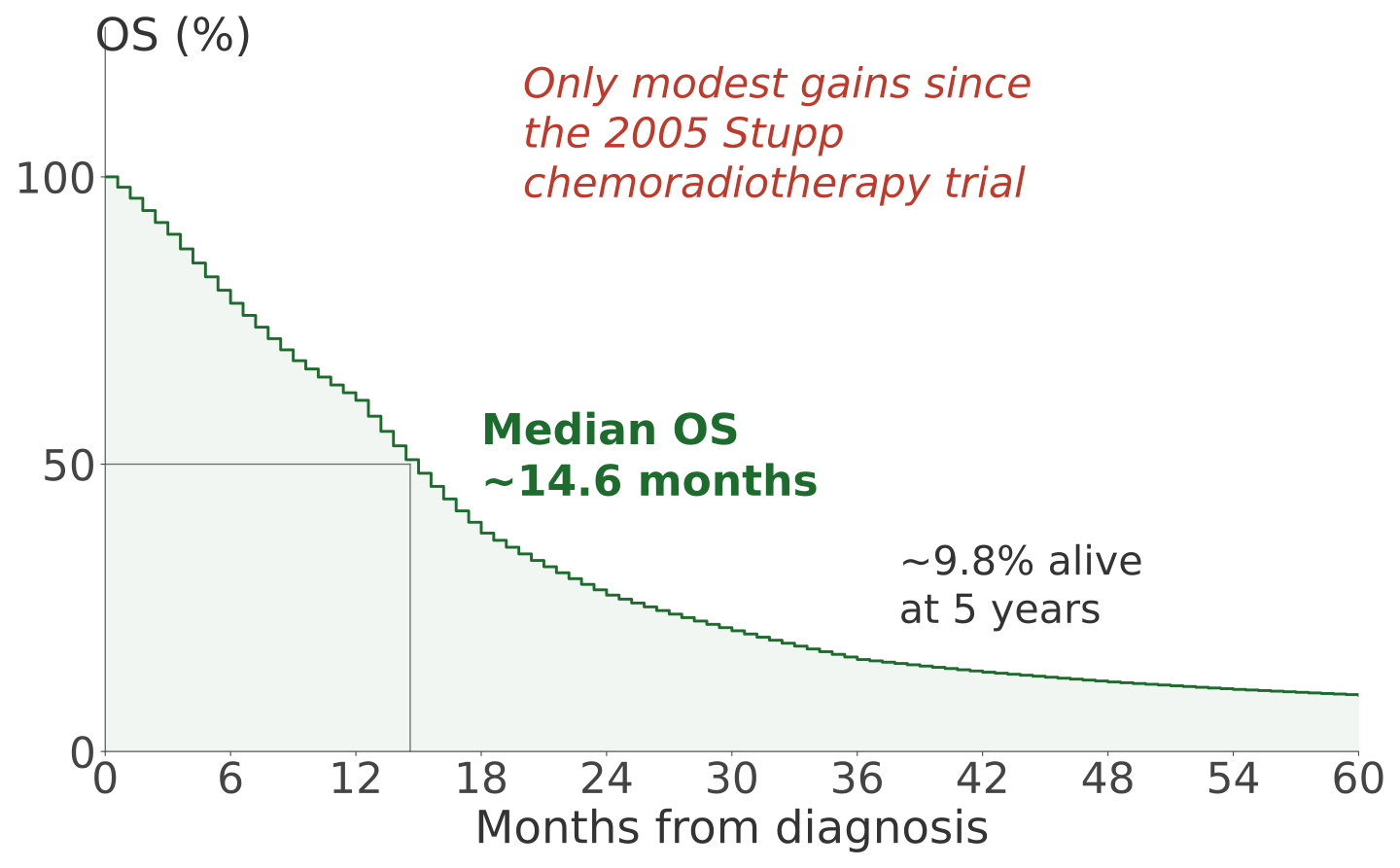
Incremental improvements to existing agents have not moved the survival needle. Overcoming the immunosuppressive microenvironment requires genuine mechanistic innovation - new targets, not better dosing of failed drugs.6, 10
Epigenetic reprogramming is a compelling frontier. GBM co-opts chromatin complexes including LSD1/CoREST to silence immune-activating genes and endogenous retroviral elements, enabling immune evasion.4, 5
BEA-17 binds LSD1, disrupts its interaction with CoREST, and destabilises both proteins. By dismantling the complex, it eliminates LSD1's catalytic and scaffolding functions. Paired with a predictive biomarker strategy, this approach aims to identify the patients most likely to respond.1, 2
Lysine-specific demethylase 1 (LSD1, also known as KDM1A) is a histone demethylase that removes activating methyl marks from H3K4me1/2. Preclinical GBM studies show that LSD1 and CoREST proteins support the viability and tumour-propagating potential of glioblastoma stem-like cells.11, 12
The LSD1/CoREST complex acts as a master epigenetic repressor: it silences tumour-suppressor genes, restricts differentiation, and maintains the glioma stem-cell state that underpins treatment resistance and recurrence.12
LSD1 also has non-catalytic scaffolding functions that contribute to tumour survival signalling. Catalytic inhibitors leave these functions intact; degrading LSD1 removes both its catalytic and scaffolding functions.1, 12
Beyond its cell-intrinsic roles, LSD1/CoREST orchestrates tumour immune evasion. The complex represses immune-stimulatory genes, including type I interferon pathway components, and silences endogenous retroviral elements that would otherwise act as immunogenic double-stranded RNA.4, 5
Preclinical studies show that relieving this silencing activates double-stranded RNA sensing through MAVS/STING and triggers interferon responses that make tumour cells more visible to the immune system.4, 5
Dismantling the LSD1/CoREST complex therefore remodels the tumour epigenome in two complementary ways: reactivating anti-tumour immune gene programmes and de-repressing endogenous-retrovirus-mediated innate immune signalling.4, 5
GBM does not exist in isolation. Its tumour microenvironment contains immunosuppressive macrophages, regulatory T cells, and dysfunctional T cells shaped by signals from the cancer cells themselves.6, 10
In preclinical GBM models, BEA-17 reactivates interferon and immune-signalling pathways, shifting the tumour microenvironment from immunosuppressive toward immune-permissive and making tumour cells more visible to cytotoxic T cells.1, 3
The ongoing GLIOMATCH project measures tumour-host interactions through spatial and single-cell multi-omics. GLIOBREAK applies this expertise to capture BEA-17-driven immune remodelling through candidate pharmacodynamic biomarkers.3, 13
BEA-17 is a first-in-class investigational small-molecule degrader of the LSD1/CoREST complex. It binds LSD1, disrupts the LSD1/CoREST interaction, and destabilises both proteins, triggering their degradation rather than inhibiting LSD1 catalysis alone. Degradation of LSD1 removes both its catalytic and scaffolding functions.1, 2, 3
This non-PROTAC mechanism is sometimes termed a monovalent degrader acting via indirect E3-target dimerisation. Unlike a PROTAC or classic molecular glue, BEA-17 does not directly create an E3-target interaction. Isocotoin provides a published precedent for destabilising a protein complex by disrupting the interaction between its partners.1, 14
The programme hypothesis is that baseline LSD1/CoREST activity and immune-suppressive transcriptional signatures may help identify patients more likely to respond; this requires prospective validation. GLIOBREAK embeds biomarker science from the outset to avoid this pitfall.
KU Leuven contributes single-cell multi-omics profiling of matched pre- and post-treatment GBM biopsies, characterising the epigenetic and immune state at baseline and assessing potential BEA-17-driven remodelling of the tumour microenvironment. This generates a companion diagnostic hypothesis as an integral programme output.14
GLIOBREAK aims to assemble the preclinical and regulatory package needed to support a future CTA or IND, including GLP toxicology, bioanalytical method qualification, regulatory documentation, and formulation work. Submission remains a project target and depends on successful completion of the planned studies and regulatory review.2
Any future first-in-human study design, patient population, or combination strategy will depend on completion of the preclinical programme, regulatory feedback, and clinical-trial authorisation.
In GBM, the LSD1/CoREST protein complex acts as a master silencer. It switches off genes that would normally alert the immune system to the tumour and suppresses retroviral elements that would trigger an innate immune alarm. The tumour becomes invisible to the patient's immune defences.
BEA-17 is a small molecule that binds LSD1, disrupts the LSD1/CoREST interaction, and triggers degradation of both proteins. Unlike catalytic LSD1 inhibitors, BEA-17 dismantles the complex, eliminating LSD1's catalytic and scaffolding functions.1
Once LSD1/CoREST is degraded, preclinical studies show that silenced immune genes and retroviral elements reactivate, triggering innate immune sensors including the STING/MAVS pathway. Tumour cells begin broadcasting immune alarm signals, making them visible to cytotoxic T cells. Whether this translates into clinical benefit for patients has not been established.
