No matching terms.
- Catalytic vs. scaffolding function
- A protein's catalytic function is its direct chemical activity; its scaffolding function is its role in holding other proteins together in a complex. Removing a protein may address both functions, whereas an inhibitor may affect only its catalytic activity.
- CoREST
- A family of gene-regulating corepressor proteins that partners with LSD1. RCOR1 and RCOR2 are also called CoREST1 and CoREST2.
- CTA / IND
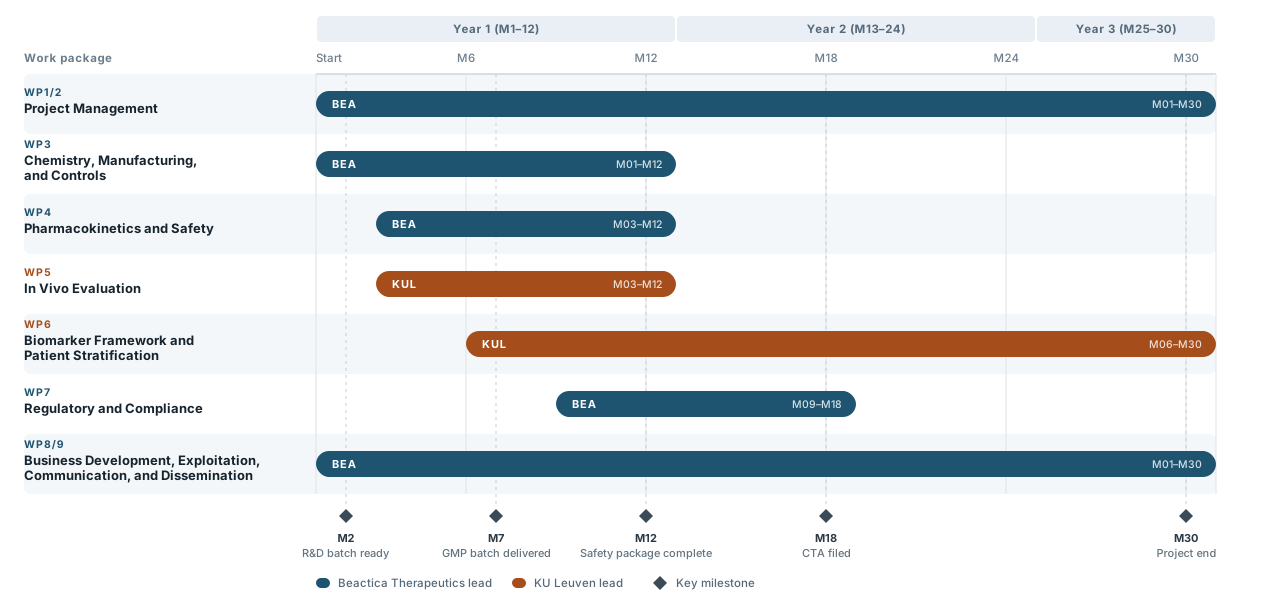
- Clinical Trial Application (EU) and Investigational New Drug application (US): regulatory submissions used to request permission to begin testing an investigational treatment in humans.
- Degrader / destabiliser mechanism
- A small molecule that disrupts an existing interaction that normally stabilises a protein complex, leaving one or more partners vulnerable to degradation. Unlike a PROTAC, it does not directly bridge the target to an E3 ligase. BEA-17 is a degrader of the LSD1/CoREST complex.
- EIC Transition
- A European Innovation Council funding instrument that supports projects moving promising laboratory research toward technological, market, or clinical readiness. It is GLIOBREAK's funding mechanism.
- Endogenous retroviral elements (ERVs)
- Virus-like DNA sequences inherited within the genome. When expressed, some can produce RNA that activates innate immune signalling.
- Epigenetic regulator
- A protein or mechanism that controls gene activity without changing the underlying DNA sequence.
- FoxP3
- A transcription factor important for the development, identity, and suppressive function of regulatory T cells.
- Glioblastoma (GBM)
- The most common and aggressive form of primary malignant brain tumour in adults.
- GLP toxicology
- Safety testing conducted under Good Laboratory Practice, a regulated quality system used to support clinical-trial applications.
- IND-enabling studies
- The preclinical safety, manufacturing, and related studies assembled to support a request to begin testing an investigational treatment in humans. The exact requirements depend on the regulator and development programme.
- LSD1 (KDM1A)
- An enzyme, also called lysine-specific demethylase 1, that removes chemical marks from proteins that package DNA and thereby helps control which genes are switched on or off.
- MHC-II
- Major histocompatibility complex class II: molecules that display peptide fragments to CD4-positive T cells as part of antigen presentation.
- Orphan Drug Designation
- A regulatory status for investigational therapies intended for rare diseases. It may provide development incentives, but it is not marketing approval and does not establish efficacy or safety.
- Pharmacodynamic biomarker
- A measurable indicator used to assess whether a drug is having its intended biological effect.
- Preclinical
- The research stage before a drug is tested in humans, including laboratory and animal studies.
- Predictive biomarker
- A measurable indicator investigated or used to identify, in advance, which patients are more likely to respond to a treatment. A candidate biomarker requires suitable analytical and clinical validation before patient-selection use.
- RCOR1 / RCOR2
- Two related corepressor proteins, also called CoREST1 and CoREST2, that can form gene-regulating complexes with LSD1 and other proteins.
- Regulatory T cells (Tregs)
- A subset of T cells that restrains immune responses and helps prevent excessive immune activation; tumours can exploit this suppressive function.
- Targeted protein degradation / degrader
- An umbrella term for drug approaches that reduce the amount of a target protein rather than only blocking one activity. PROTACs, molecular glues, and interaction-destabilising approaches work through different mechanisms; not every degrader is a PROTAC.
- Tumour immune evasion
- Mechanisms that tumours use to avoid detection and attack by the immune system.
Definitions are plain-language summaries. Scientific and regulatory usage may depend on context.